
A brief look at the great story of Peter Jackson’s great trilogy

The first time I saw The Lord of the Rings was when I was quite young, under the age of 10. The trilogy was being broadcast on local TV, but unfortunately, I didn’t fully grasp the film’s essence back then, and my introduction to the saga began oddly — with the third installment, The Return of the King. My family, in the midst of their typical evening TV browsing, landed on a channel showing a random movie. I remember seeing two men fishing by a river on the screen, when suddenly they began fighting over a mysterious ring. It was at that moment I fell in love with cinema, drawn in by the very first frames of a story I had never seen before, even without understanding the events unfolding before me.
Later, in my more conscious years, I rewatched the trilogy in its entirety. Only then did I feel the full power of cinema and understand its purpose. From that moment on, I made it a tradition to rewatch the trilogy every year before New Year’s Eve.
Now that the nostalgic introduction is out of the way, let’s dive into the details of Peter Jackson’s masterpiece. In this review, I aim to provide my thoughts on the trilogy, having watched it more than ten times.
Context and Meaning
When Peter Jackson announced he would be adapting J.R.R. Tolkien’s iconic novel for the big screen, many were skeptical. How could such a sprawling epic be successfully translated to film while preserving its depth and spirit? Yet Jackson not only succeeded — he created a phenomenon.
The trilogy set new standards for fantasy cinema, excelling not only in its visual and technical achievements but also in its emotional resonance. Stories of elves and orcs were no longer relegated to animated Disney films; fantasy as a genre was no longer confined to King Arthur legends or Merlin’s magic. Jackson proved that fantasy films could be serious works of art — with philosophical undertones, breathtaking visuals, billion-dollar box office returns, massive budgets, acclaimed actors, and enduring impact on the film industry.
It’s worth noting that Peter Jackson didn’t invent an extraordinary story — he masterfully brought Tolkien’s epic novel to life on screen with his unique vision. The result? An astonishing 17 Academy Awards out of 30 nominations. The final film, The Return of the King, swept all 11 categories it was nominated for, setting a record for the most Oscars ever won by a single film.
Direction and Screenplay
Peter Jackson’s direction is nothing short of impeccable. He skillfully balanced drama, action, love, betrayal, friendship, and vast-scale world-building, while grounding the audience in the deeply personal emotions of each character. I imagine that when Tolkien envisioned his world, it must have looked remarkably similar to Jackson’s interpretation.
The screenplay adeptly adapts the complex narrative of the novel. Of course, some elements from the books were altered or omitted, but the films still feel complete and cohesive. There’s no sense of emptiness or missing pieces, and the extended editions of the trilogy merely add depth to the lore rather than patching any plot holes.
Acting
If the cast were replaced today, I imagine the result might feel like something Netflix produced (and perhaps that madness already exists in the form of a certain series).
Ian McKellen as Gandalf is sheer perfection. His portrayal captures both the wisdom of an ageless spirit and the fragility of an elderly man in mortal form.
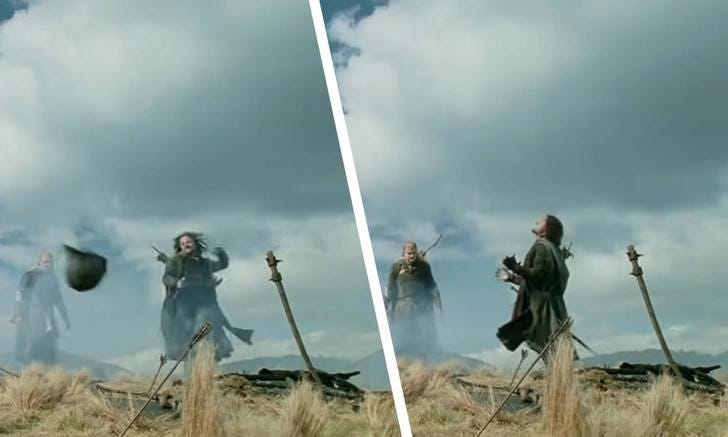
Viggo Mortensen’s Aragorn is a triumph, transforming the character from a mere literary figure into a living, breathing man full of doubt and grandeur. His journey from a humble ranger to a king is one of the trilogy’s most inspiring arcs. Mortensen’s dedication to the role is equally impressive — take, for instance, the iconic scene in The Two Towers when Aragorn kicks a helmet in frustration. Mortensen broke his toes in the process but stayed in character, delivering an emotionally charged performance that remains unforgettable.
Andy Serkis as Gollum not only revolutionized motion-capture acting but also laid the groundwork for its widespread use in modern cinema. Gollum feels like a real, tangible creature to this day.
Elijah Wood and Sean Astin, as Frodo and Sam, are the heart of the trilogy. Their dynamic exemplifies how friendship can be both a source of salvation and a reservoir of strength. Wood masterfully portrays Frodo’s slow but inevitable succumbing to the Ring’s influence, while Astin’s Sam radiates a brotherly devotion that anchors Frodo in his darkest moments. Even the supporting cast brought unforgettable depth to their characters, making Middle-earth feel truly alive.
Visual Aesthetics
Every frame of the trilogy is a work of art. Andrew Lesnie’s cinematography immerses viewers in Middle-earth, making it feel as though we’re not just observing the world, but stepping into it. The landscapes of New Zealand serve as the perfect backdrop for the story, with majestic mountains, endless plains, and haunting forests brought to life on screen.
The attention to detail in portraying iconic locations — be it the endless corridors of Moria, the towering splendor of Minas Tirith, the eerie ruins of Minas Morgul, or the windswept plains of Rohan — is breathtaking. The Battle of Helm’s Deep, in particular, remains one of the greatest cinematic battles of all time.
Music and Sound
How many instruments were used to compose the theme of Rohan? I’d guess all of them. As someone who once tried playing Edoras’ theme on both guitar and ukulele, I can attest to how iconic Howard Shore’s score is.
Shore’s music is as essential to the trilogy as Jackson’s direction. His soundtrack doesn’t just accompany the story — it becomes part of it. Each location, each character, each moment has its own musical identity. The music communicates emotions so powerfully that even without dialogue, you understand everything. It’s as if the melodies themselves are narrating the story.
I’ll just leave the playlist in lieu of superfluous words. Words are redundant here.
The revolutionary work of Weta Workshop forever changed the way visual effects are approached in filmmaking. Gollum, for example, remains a milestone in CGI and motion-capture technology. The practical effects, makeup, and props are equally remarkable. I would like to remind you that John Rhys-Davies, who played Gimli, is 1.85 meters tall.
Themes and Philosophy
The trilogy explores universal themes: the lure of power, the cost of friendship, sacrifice, and the enduring nature of hope. The One Ring serves as a metaphor for the corrupting influence of power, while Gollum’s tragic tale warns of how easily one can lose themselves to obsession.
Each storyline underscores the idea that even the smallest actions can change the world. Frodo, far from being a conventional hero, succeeds because of his vulnerability, not in spite of it. Gandalf’s unwavering faith, Aragorn’s acceptance of his destiny, and countless other moments remind us why these films resonate on such a profound level.
Conclusion
Now, over 20 years since the release of the first film, The Lord of the Rings remains a benchmark in cinema. Many projects, from Game of Thrones to The Wheel of Time, owe their popularity to its influence. Yet none have matched its emotional depth. With each annual rewatch, I discover new details — most recently, a deeper understanding of Saruman’s motives and how his opportunism contrasts with Gandalf’s steadfastness.
The Lord of the Rings is more than just a film — it’s an experience. It’s a story of hope and courage, told with such mastery that it continues to inspire. If you haven’t watched it in a while, do so. If you’ve never seen it, make it a priority. These films remind us that cinema’s greatness lies not only in its technology but in its ability to touch the human soul.
“It’s not difficult to imagine a green sun. The hard part is creating a world where it feels natural.”
— J.R.R. Tolkien
 Renas Media