
Does Quentin Tarantino promote violence in his movies to the same extent?
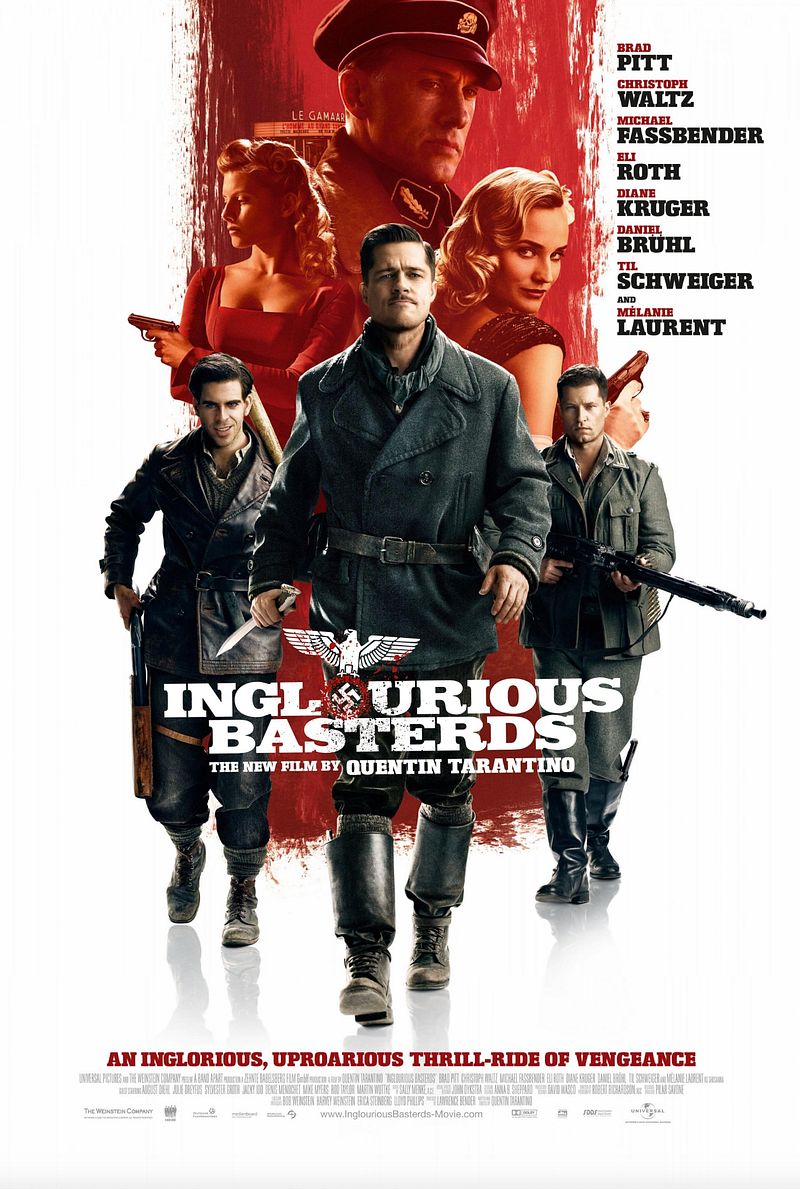
Quentin Tarantino is one of the most influential directors in today’s film industry, known for his bold and distinctive style. His film “Inglourious Basterds” is yet another testament to his boundless love for cinema.
“Inglourious Basterds” is a perfect example of Tarantino’s trademark style, filled with references to films by other directors, starting with its very title. This film stands out as one of the most daring and unconventional works in his career, as it departs from the usual focus on smaller, personal conflicts. Instead, “Inglourious Basterds “intertwines historical events with complex global themes, offering a unique perspective on war and revenge.
Style and Plot
As mentioned, the film is rich with references to other films, but it is also full of metaphors and visual contrasts. One memorable scene takes place at the farmer’s house, where Hans Landa, with his large, unusual smoking pipe, exudes dominance and power, in contrast to the humble pipe of the farmer Lapadita, who finds himself trapped in a tense, unavoidable situation. This contrast is also evident in the film’s violent scenes, such as when scalping is accompanied by humorous dialogue. Tarantino’s ability to highlight contrasts in characters, culture, ideologies, and manners — between reality and fictionalized history — makes this film stand out. His unique style, which we love, comes from how he builds his narratives through seemingly insignificant details as well as grand “elephants in the room,” setting up climactic moments with subtle “Chekhov’s guns” and references to culture, other films, and literature that become clearer with multiple viewings.
“Inglourious Basterds” marks a turning point where Tarantino realizes the changing nature of cinema. The film presents an epic, over-the-top visual history, filled with dramatic effects. The plot itself resembles a quirky mosaic made of conflicting genres: a group of Jewish soldiers, led by Lieutenant Aldo Raine, hunts down Nazis, while a young Jewish-French woman plots her own revenge. These storylines converge in a final scene that is literally explosive.
The film’s finale is perhaps the boldest moment in Tarantino’s career, blurring the lines between real history and his own artistic ambitions. He destroys the symbols of Nazi power with theatrical brutality. It’s a quintessential Tarantino move that, surprisingly, works. “Inglourious Basterds” doesn’t strive for historical accuracy, but it is filled with emotions — grief over lost loved ones, fear of the future, and the ease of self-assurance.
At its core, the film explores revenge, a common theme in Tarantino’s works. It presents various forms of vengeance: personal and collective, public and hidden. Revenge here is not limited to violent acts; it is deeply symbolic. For instance, Shosanna’s final act, turning her vengeance into a public execution on the cinema screen, is a powerful moment. The moral ambiguity of revenge is evident, as it leads to horrific consequences, yet provides a form of liberation for the characters, who, despite their cruelty, are hard not to admire.
Perhaps Tarantino’s films convey the idea that “violence begets violence,” and no matter how much we strive for peace, there will always be a place for vengeance in the world.
Visuals
“Inglourious Basterds” was shot on 35mm film, which gives the movie a visual warmth and retro style. The use of film rather than digital footage helps create the feeling that the viewer is not just watching a movie, but experiencing a piece of history from a specific era. This technique allows Tarantino to create a unique atmosphere that blends the aesthetics of 1960s-70s cinema with modern elements.
Tarantino’s visual style makes the film instantly recognizable and contributes to its unique atmosphere. The scenes are carefully composed, with every element on screen serving a purpose. For example, the scenes with Hans Landa and Shosanna feature simple backgrounds like wooden walls or home interiors, emphasizing the psychological tension between the characters. The attention to light and color — bold contrasts — creates a sense of drama and heightens the atmosphere of menace.
Attention to detail is another key element of Tarantino’s visual style. Every frame, from Shosanna’s red lipstick to the symbols in the cinema, contains clues that deepen the emotional weight and symbolism of the film. These details are not mere decoration but integral to the narrative, helping the viewer understand the characters’ motivations and the overall tone of the film.
Music
The music in “Inglourious Basterds” is another standout feature. As usual, Tarantino doesn’t rely on an original score but instead selects songs from different eras and genres. From Ennio Morricone’s Italian spaghetti western scores to David Bowie, the music becomes an emotional anchor for the audience. For example, “Cat People (Putting Out Fire)” by Bowie, played as Shosanna prepares for the final scene, adds a mythical quality to the character. The soundtrack intertwines with the action on screen, highlighting the drama or adding irony in just the right moments.
Acting
Christoph Waltz’s portrayal of Hans Landa captivates the viewer; his scenes are moments of intense anticipation. Waltz expertly portrays a sophisticated, elegant, and chillingly cold character. Landa reminds me of Buster Scruggs (played by Tim Blake Nelson) from “The Ballad of Buster Scruggs” — there’s something similar in their personalities.
Brad Pitt, as Lieutenant Aldo Raine, brings much-needed grotesque humor to the film. His southern accent, mannerisms, and exaggerated cruelty create a character that walks the line between absurdity and heroism.
Melanie Laurent brings quiet but powerful intensity to her role as Shosanna. Her gaze says more than words ever could, especially in scenes with Landa.
The famous bar scene with the Nazi officers during the tense game is another unforgettable moment, largely due to the actors’ performances.
Dialogues
Tarantino’s trademark is undoubtedly his sharp dialogue. In “Inglourious Basterds”, the dialogue is one of the film’s most striking elements, creating a unique atmosphere and adding depth to the characters. Tarantino excels at crafting conversations that are witty, tense, and multi-layered. Every dialogue not only helps reveal the characters but also builds tension. For instance, the scene with Hans Landa at Shosanna’s house is unforgettable due to his manipulative communication style, where every word counts, and pauses and shifts in tone amplify the psychological pressure.
Tarantino’s dialogues also often serve as “traps,” where humor and irony blend with the seriousness of the situation. A perfect example is the conversation between Aldo Raine and the Nazi officers in the bar, where the tension gradually escalates until it erupts into a brutal climax. The dialogues make the film not only visually striking but intellectually rich, where every word holds significance, contributing to an unparalleled atmosphere.
A New Era (Film’s Cultural Impact)
Some may criticize Tarantino for his excessive use of violence or for being superficial about the tragedies of war. But this is precisely his intent: he uses tragedy as a foundation for creating something new, provocative, and artificial. This is not a documentary; it is a meta-history, where emotions and symbols matter more than facts.
“Inglourious Basterds” became not just another successful project for Tarantino but also an important cultural event, having a profound impact on world cinema. It solidified Tarantino’s status as a master of postmodernism and changed the approach to historical narratives, genre experiments, and cinematic techniques. He introduced the trend of rewriting historical events with artistic liberty. He showed that history is not a dogma but a tool for creating powerful, emotional storytelling.
Conclusion
“Inglourious Basterds” is a unique combination of tragedy, comedy, and western, infused with Tarantino’s signature style: tense dialogues, vivid characters, and brutal scenes. The visual style, from the 35mm film to the contrasting colors, creates unforgettable imagery, while the theme of revenge drives the plot, exploring moral dilemmas and tragic consequences. Revenge here is not only a personal or collective act of retaliation but also a symbol of liberation, despite its destructive power.
It is a multi-layered work that not only entertains but also makes us think about the nature of violence and history, turning every detail of the film into a part of a profound philosophical narrative.
 Renas Media