
The Seventh Seal is a haunting exploration of faith, mortality, and humanity’s search for meaning in the face of an indifferent universe.
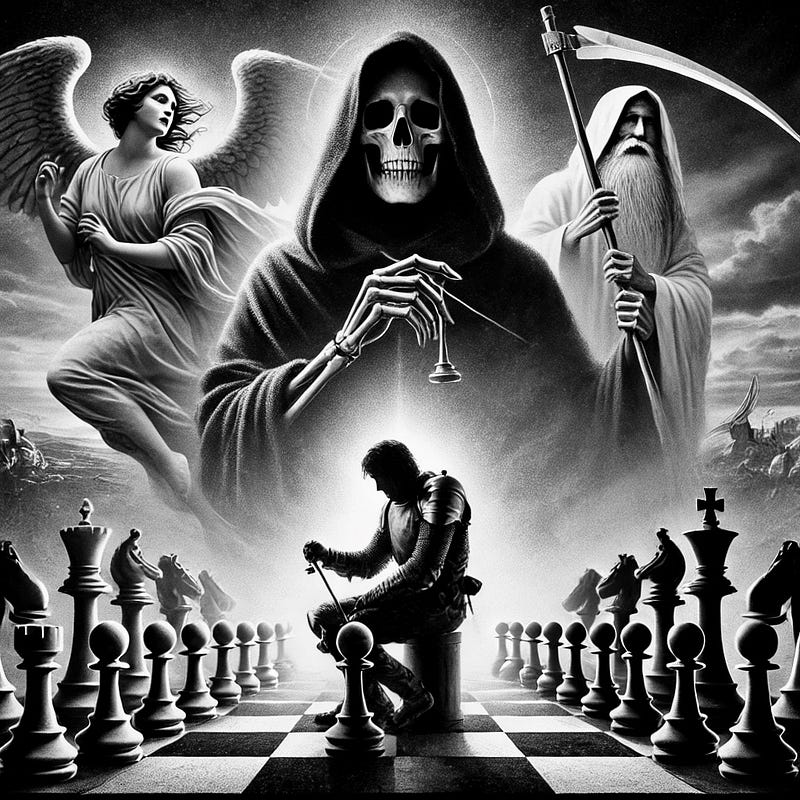
The film tells the story of a knight named Antonius Block, who, after years of crusading, returns home only to encounter the Angel of Death along the way. He proposes a game of chess with Death to gain a temporary reprieve. Block uses this time to seek answers to a question that has long tormented him: why is God silent? The medieval setting — marked by the plague and a desperate populace willing to burn others in hopes of salvation — perfectly complements the film’s central idea. The atmosphere is steeped in darkness and that sense of inevitability when one understands the end is near and waits for it in resigned acceptance.
In my opinion, Block represents Bergman himself, posing the same question about the meaning of existence. The film was created in the post-war period when humanity was recovering from the horrors of war. I believe many people at the time were grappling with similar existential questions, having endured immense suffering and confronted their own “plague.” The contrast between the pragmatic squire, who accepts reality, and the knight, who rejects blind faith and seeks concrete answers to his questions, is striking. Yet, Block receives only veiled, ambiguous responses. Like so many throughout human history, Block asks the eternal question that remains unanswered, met only with silence. As in the film, where people fear both God and the Devil, so too in reality, humans grapple with the concepts of good and evil, God and the Devil, yet face death with less wonder, only fear that their time has come.
The chess game, which spans the entire film, is one of the most unusual scenes in cinema. The deep symbolism of the white Block and the black Death illustrates how, even knowing the outcome and who will win, we still challenge fate or watch the game with great fascination. That is our nature. I dare to suggest that the chess game is an allegory for human life. It begins with trembling anticipation and ends when the time comes. A game where we know the result but still try to outwit our opponent, though the outcome is predetermined. The entire film is rich with symbolism — seen in the actors’ masks, the silent dead who say so much, and the contrasts of white and black, life and death.
The film also draws a parallel between death and new life. The acrobat’s son symbolizes a new future, a new life. Even in such grim times, plagued by disease, death, and fear of Judgment Day, there is still room for joy, sincere love, and care, which inspire us to cherish every moment. New life is beyond even death’s grasp. This is evident when Death declares she will take all of Antonius Block’s companions, yet the acrobat’s family escapes their fate by leaving early, braving a dark night amid a raging storm.
In some ways, I share the director’s philosophy. My first viewing of this masterpiece likely contributed to shaping my worldview. Prolonged reflection on higher powers often leads to a certain disenchantment with religious teachings, yet we persist in our search for the divine. I think many readers of this article have also questioned the correctness of religion, pondering the silence of higher powers, the purpose and meaning of life. Could it be that we are just another species at this stage of evolution? Perhaps — most likely. This film is remarkable not because it provides answers or sparks fantasies, but because The Seventh Seal confronts us with questions — questions that have long lingered in the history of human thought. The author boldly raises these ideas, challenging all teachings and resignation.
One moment in the film stands out: the Inquisition preparing to execute a young girl accused of speaking with the Devil. In this scene, I noticed the very dissonance the author feels — humans are willing to accept evil, knowing the Devil walks among them, yet they continue to question God’s existence. Perhaps this stems from human nature; we are more inclined to believe in earthly evil than in heavenly good.
In my opinion, the author should have delved deeper into the relationship between the knight and the squire. Two individuals with opposing worldviews would have perfectly complemented the film’s contrasts. The theme of their relationship was touched upon only superficially, and the absence of one or two additional dialogues that could have better revealed the squire’s perspective feels noticeable.
In conclusion, The Seventh Seal is a profoundly philosophical film. Many viewers will find echoes of their own long-held reflections within it, particularly about the silence that greets us in return. This film is undeniably worth watching — multiple times, even.
Hur ska man tro på de troende, när man inte ens tror på sig själv? Vad ska bli med oss, som vill tro men inte kan? Och vad ska bli med de som inte vill och inte kan tro? — Antonius Block
 Renas Media