
The article was prepared and presented by Renas Media in the form of a presentation for novice and experienced entrepreneurs in Finland with the help of KOSEK, Kokkolanseudun Kehitys Oy
My work has become more productive, and I can share my experience thanks to two leading specialists and business developers from KOSEK – Anastassia Häggblom and Sami Viljanen.
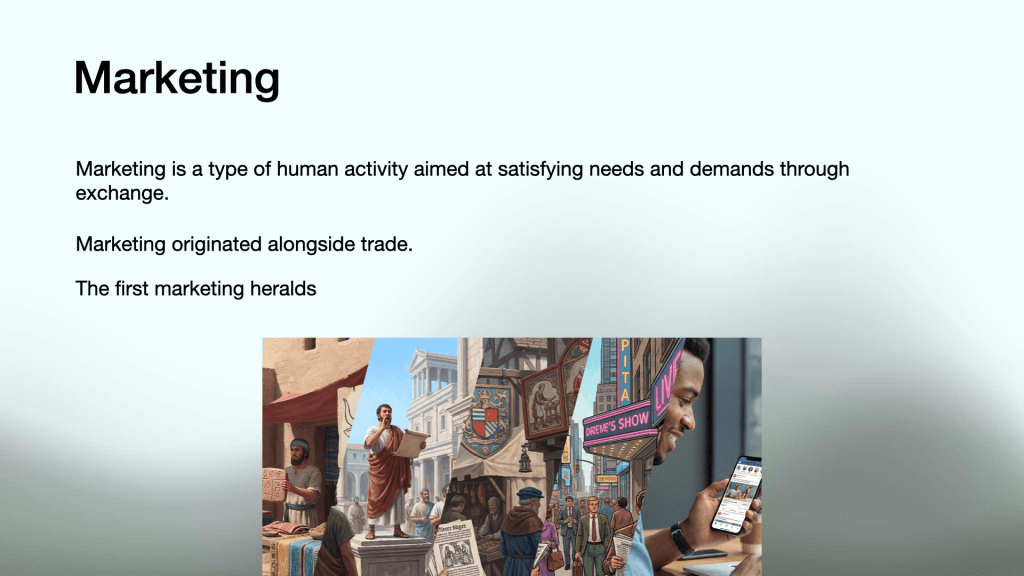
Marketing is primarily a system of human activity through the instrument of exchange, i.e., trade. Since ancient times, people have exchanged one commodity for another, services for barter, and so on.
Throughout history, as is the case today, it has been important to stand out from the crowd and promote oneself and one’s business and product. Various methods have been used as tools for this, from town criers to modern social networks and neurobots.
Marketing is a way of communicating with customers.
Through marketing channels, we can identify our customers, understand what they need, determine value, make offers, close deals, and reinvest in new deals with customers.
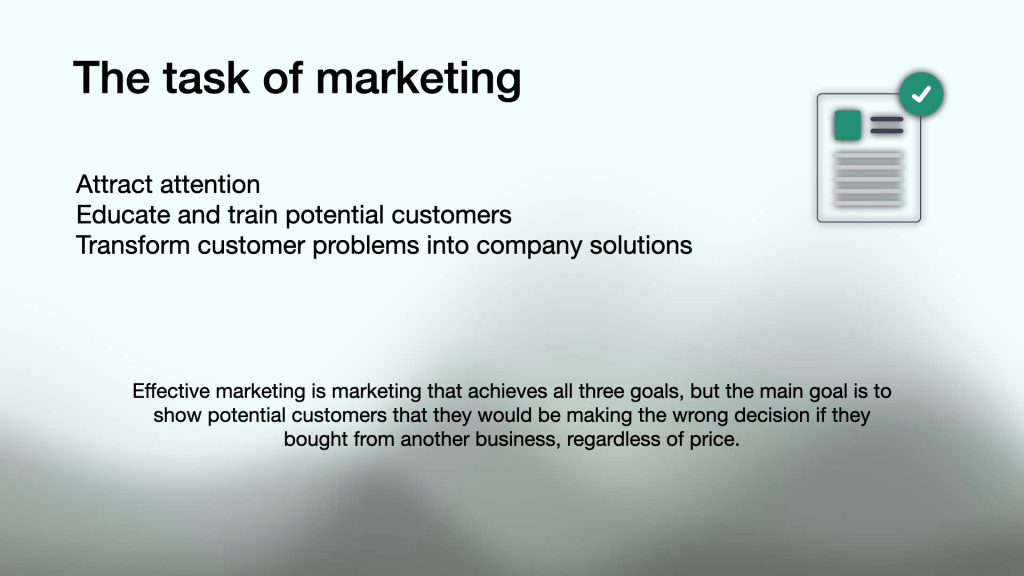
- Attract attention. For a product or service to start selling, a company must attract the attention of its target or potential customers. This task seems simple, but it requires strategic planning and a series of actions to accomplish.
- Educate potential customers. Companies need to provide them with educational information that will make it easier for them to decide to purchase a product or service. People trust brands that offer support and provide educational content.
The task of marketing is to determine what is most important to potential customers. Then, find ways to communicate what the best offer in the field is. And provide evidence that the company offers the best deal in terms of price and value.
- Transform customer problems into company solutions. Companies offer customers specific, low-risk, and easy-to-execute actions that make it even easier for them to make the right decision.
Potential customers receive clear and concise messages about how a product or service will solve their problem. Therefore, buyers need to be provided with reports, e-books, case studies, blogs, and other marketing materials.
The goal of marketing is business growth and customer satisfaction.
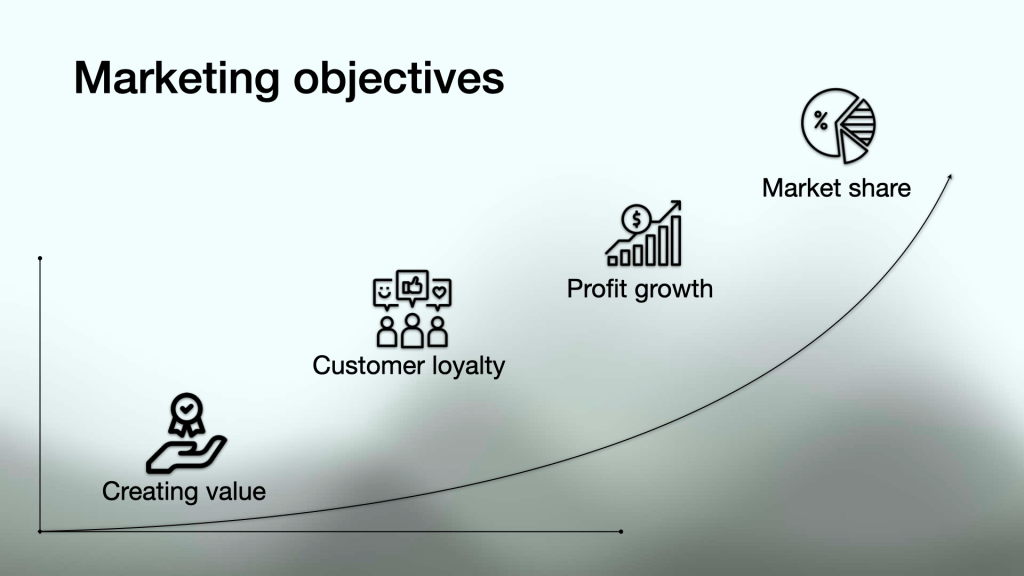
The main goal of marketing is to help a company grow and make money, even when the market is constantly changing. But a simpler and more understandable task is not to force products on people, but to deeply understand what people really need. This approach means that we study the customer’s journey, identify their problems, and come up with solutions to make it easier for them to decide to buy.
By providing real benefits, the company earns the trust of its customers: they buy again and recommend the brand to their friends. Attentive customer service requires that these rules apply to all aspects of the company’s business. Thanks to a steady stream of customers, the company grows. This generates money for development, new product creation, advertising, and large and profitable deals. By developing rapidly, the company takes its place in the market. If there are few competitors in this field, it can take half of all customers or even more.
Marketing is not just advertising – The main functions of marketing
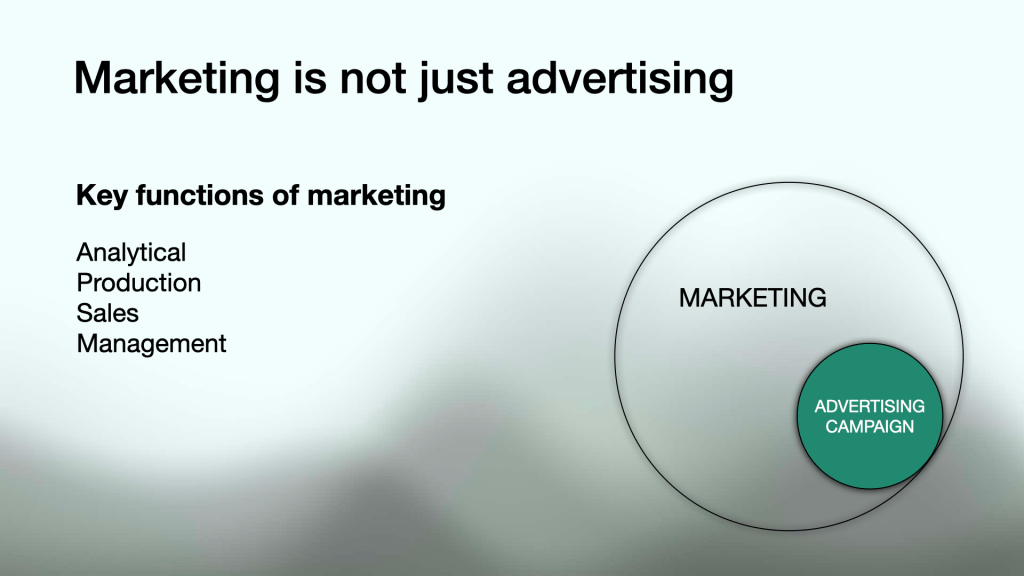
Marketing activities are structured around four interrelated functions, each of which addresses specific marketing tasks. Understanding these functions allows you to build a comprehensive management system.
Analytical
- Analytics involves the continuous collection and analysis of information about the market, competitors, and customer behaviour. It starts with general research and then moves on to specific methods such as surveys, group discussions, and testing ideas in practice. Studying the audience by age, interests, and habits helps to find groups of people with similar desires. Studying competitors helps to understand the strengths of other companies, what part of the market they occupy, and how they present themselves.
Production
- Specialists play a critical role in the product concept development stage, transforming insights about market needs into specific requirements for characteristics.Marketing influence extends to determining the optimal set of characteristics, packaging design, and the formation of an assortment matrix. Close integration with product teams ensures the creation of solutions that evoke an emotional response.
Sales
- Sales work combines efforts to raise interest in the product, select the best places to trade, and establish highquality communication. Promotion tools include advertising, reputation management, personal sales, and various promotions. Prices are set based on costs, real benefits for the buyer, and the competitive landscape. Effective communication requires that the company’s main message be consistent wherever the customer encounters the brand.
Management
- Management helps turn the overall strategy into a concrete action plan, determining the necessary resources and timelines. Success is measured by a set of key indicators that take into account both money and work processes. Goals are set according to clear and understandable rules. Regular checks allow you to spot mistakes in time and redirect the budget to where it will be most useful.
4P of marketing (Product, Price, Place, Promotion)
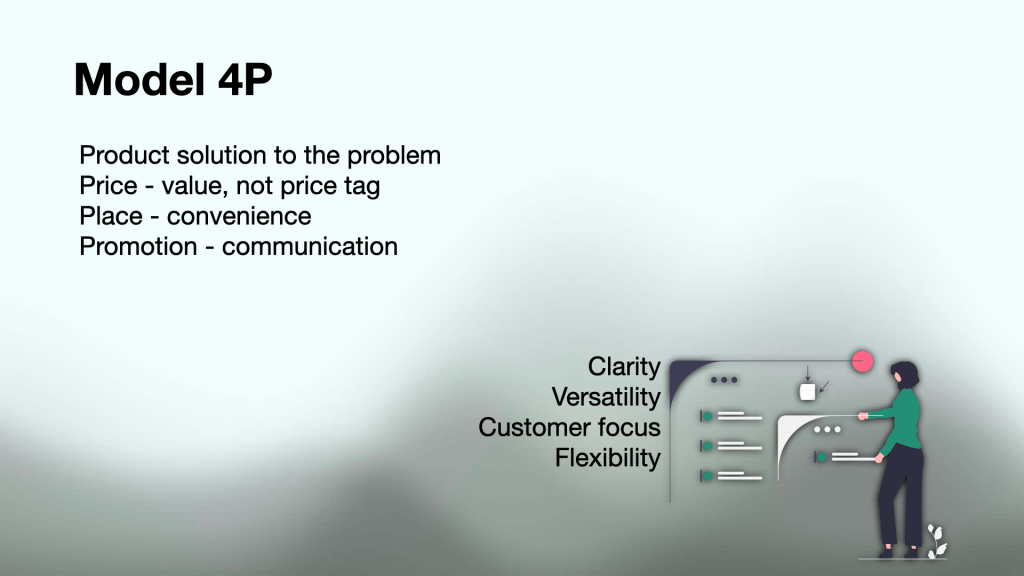
The 4P model consists of four parts: product, price, place, and promotion. Let’s look at each one separately.
- Product. What exactly does the company sell? It is important to look not only at the item itself, but also at its properties, packaging, brand awareness, quality, and what sets it apart from the rest.
- Price. How much does it cost? The price should allow the company to make a profit, but at the same time, correspond to the benefit that the customer receives.
- Place. Where can it be bought? This refers to the sales channels through which shops or websites people can find and purchase the product.
- Promotion. How to find buyers? This includes advertising, discounts, useful articles, working with famous people, and any other ways to promote yourself.
The 4P model remains popular in marketing because of its simplicity. It can be applied to any business, from tiny projects to huge companies. Let’s take a look at the advantages of this tool. 4P is a logical and clear framework that even beginners can handle. It helps to organise marketing and not miss anything important. Let’s examine the 4P model using a coffee shop as an example:
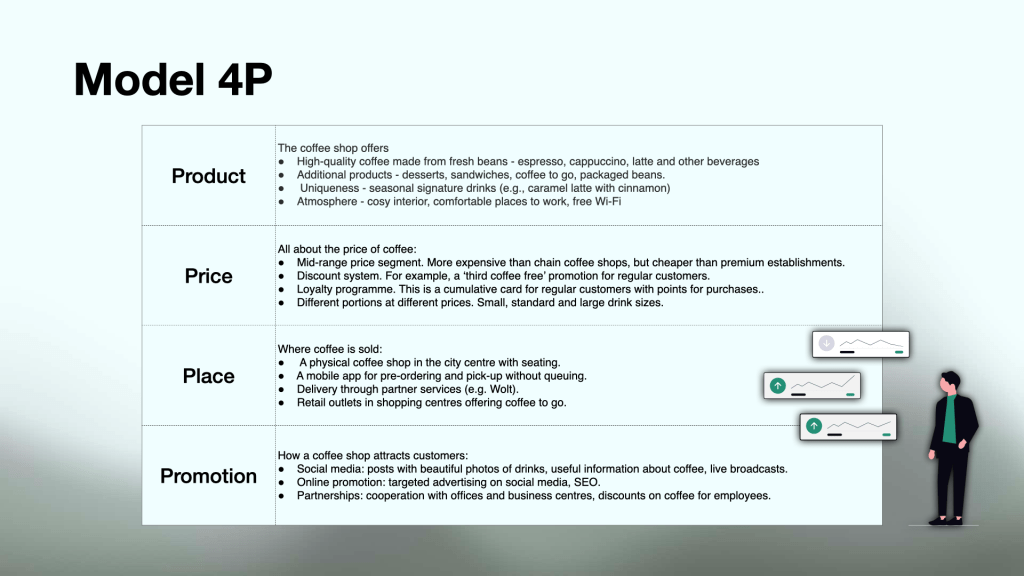
To be fair, it should be noted that the 4P marketing mix concept is the earliest, simplest and therefore most basic for practitioners around the world to apply. With the development of competition and the increasing complexity of customer relationships, other variations began to appear. However, at a later stage of planning and development, more adapted and expanded models such as 7P, 4C, and SIVA are used.
Types of marketing by consumer type
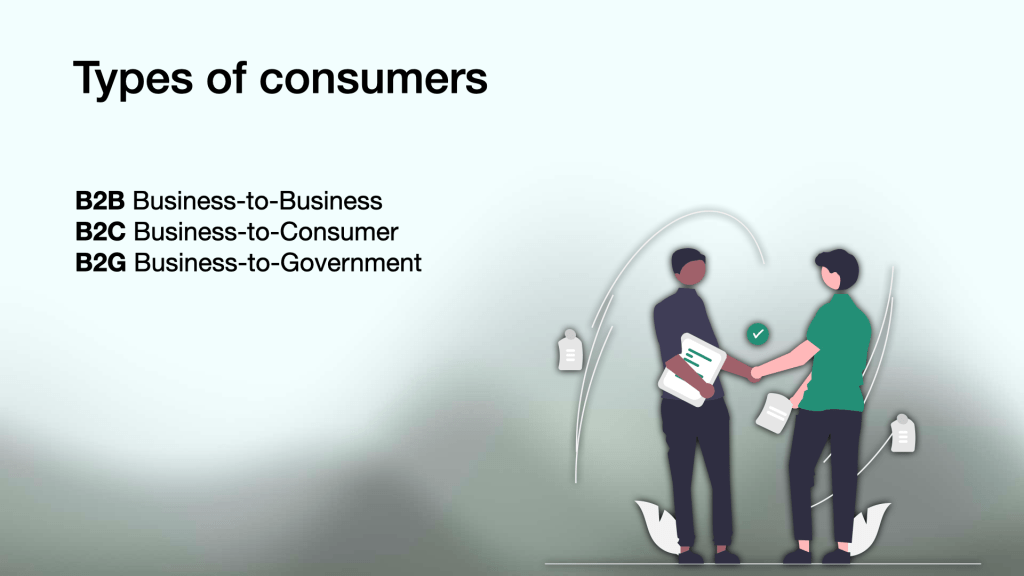
For marketing to work, you need to clearly understand who your audience is and what they need.
B2B (sales to other companies), B2C (sales to ordinary people), and B2G (working with the government) are different approaches.
Each of them is specifically tailored to its specific buyer. Now we will look at the main differences between them. Here is a simplified and slightly abridged version of the text. I have removed repetitions and complex phrases while retaining the meaning.
B2B
B2B marketing is used by companies that sell goods wholesale (materials for construction or manufacturing) or provide services to other businesses (such as project management or advertising configuration).
This market may seem small, but it is actually huge. For example, IBM alone spends more than $60 million daily on purchases for its operations. Here, the work is done with business owners or managers. The main goal is to establish relationships with people who make important decisions about cooperation. Customers in this segment study offers very carefully. They care about terms and conditions, future benefits, and how you are better than your competitors. There is a lot of advice on strategies on the internet. It is often recommended to write to customers directly. In such letters, it is important to think through every word to show professionalism and the benefits of working with you.
Unlike working with companies, ordinary people (private customers) want to receive information immediately. Their choice often depends on emotions and reviews from other people.
B2C
In B2C marketing, people look for products to meet their current needs. Therefore, they buy quickly, without much thought—they make decisions in a matter of minutes or a couple of days. To succeed, business owners need to understand customer habits, trends, and competitor actions.
Advertising should be simple, understandable, and address the customer’s problem directly. If done correctly, it will elicit the desired response and increase sales.
Features of B2C marketing:
- Quick sales. Unlike working with companies (B2B), people don’t spend a lot of time studying every detail. They often buy on the advice of friends, so the transaction is faster and easier for everyone.
- Emotions are more important than logic. People are looking for solutions to their desires “here and now” rather than making long-term plans. If a brand gives them the emotion they need and solves their problem, they will definitely come back again.
- Working directly with the buyer. You communicate personally with the person who will use the product. It is easier to convince one person than to negotiate with a whole group of bosses, as is often the business case.
- The importance of social media. You can’t do without it these days. Before making a purchase, people look for reviews on all platforms. They also like to get quick answers via chatbots. This allows companies to be available around the clock, gather opinions, and win back customers with new offers.
B2G
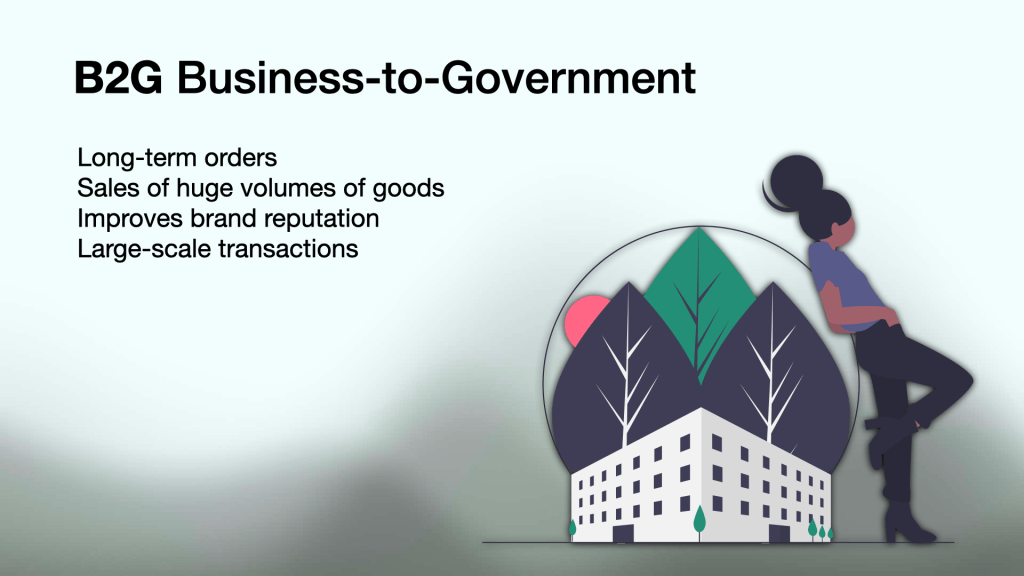
B2G is when private businesses work with government agencies. It is a complex model due to the large amount of paperwork, but it provides access to very large and lucrative deals.
Advantages of working with the government:
- Long-term work. You can get an order for several months or even years at once, which is rare in regular business.
- A good example for your portfolio. Working with government contracts raises the company’s reputation. This helps in the future to get new orders, even from private clients.
- Huge sales volumes. The government needs a lot of things: thousands of textbooks, kilometres of roads, and furniture for hospitals. One such large customer replaces a hundred small ones, which saves time and effort in finding them.
Disadvantages of this model:
- Complex competitions (tenders). Contractors are selected through a rigorous selection process. To get an order, you need to know the laws, collect a bunch of documents, and comply with strict rules.
- High responsibility. If you do a poor job, you will have to redo it at your own expense. Considering the size of the order, this can be very expensive.
- Bureaucracy. Any decision, even a simple one, can be delayed. It is difficult to change plans along the way. But the most unpleasant thing is possible delays in payment.
To avoid problems, companies hire special employees. They monitor new orders from the state and competently prepare all the documents for participation in the competition.
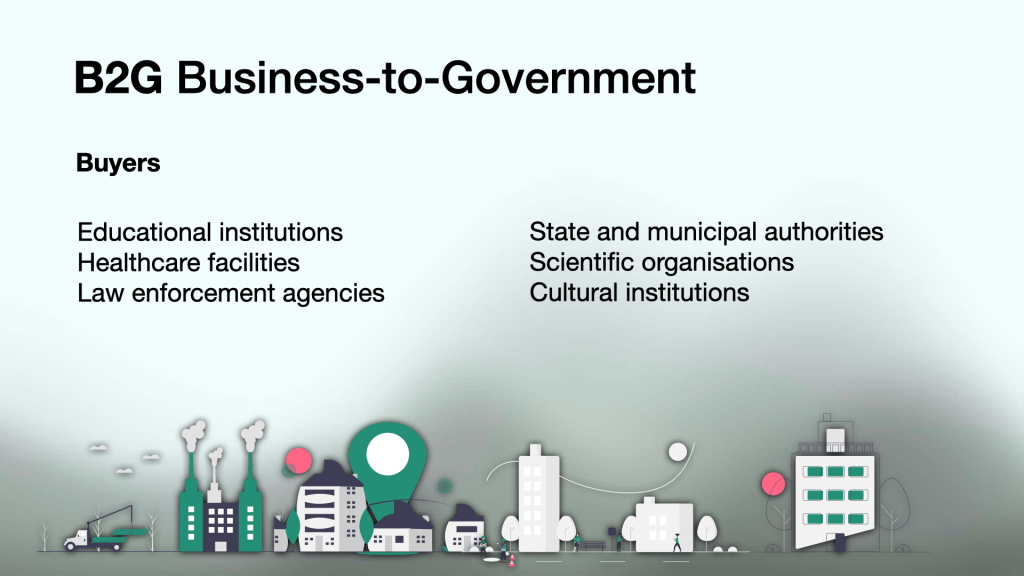
Who buys in B2G:
- Education: universities, schools, colleges, and kindergartens.
- Medicine: hospitals, clinics, ambulances, and sanatoriums.
- Law enforcement: the army, police, courts, and prisons.
- Government: parliament, ministries, city halls, and local councils.
- Science: institutes, libraries, and research centres.
- Culture: theatres, museums, and concert halls.
Analysis and Research
The purpose of the analysis is to give the company an honest view of the market situation. It is necessary to understand new trends, how consumer habits are changing, where competitors are strong, and what our own advantages are.
This helps us make the right decisions, develop sound plans, quickly adapt to changes, and successfully sell our products. When there are so many products around, any company must know exactly what product to make, how much to make, at what price, and where to sell it before launching production. The answers to these questions are provided by analysis. It can be comprehensive (research in all areas at once) or specific (to solve a specific problem right now).
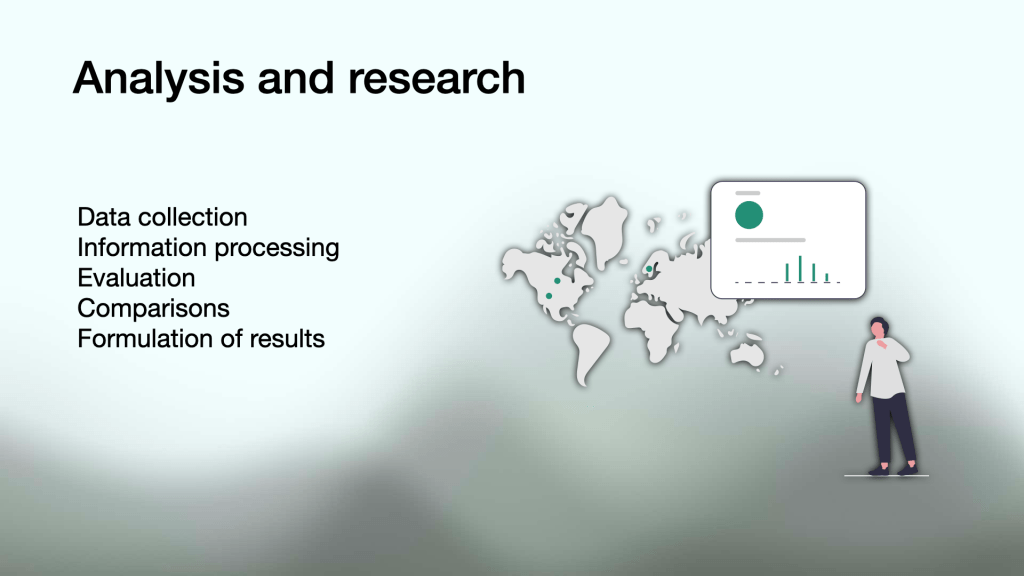
To do this, you need to go through the following steps:
- Collect all the data you can find.
- Process the information and organise it, highlighting what is most important for your business.
- Evaluate the results, discuss them with your team and experts to understand what the numbers mean.
- Check whether the results are accurate by comparing them with other similar studies and information from the internet.
- Draw conclusions based on the main goal for which you started the research.
Communication with the audience
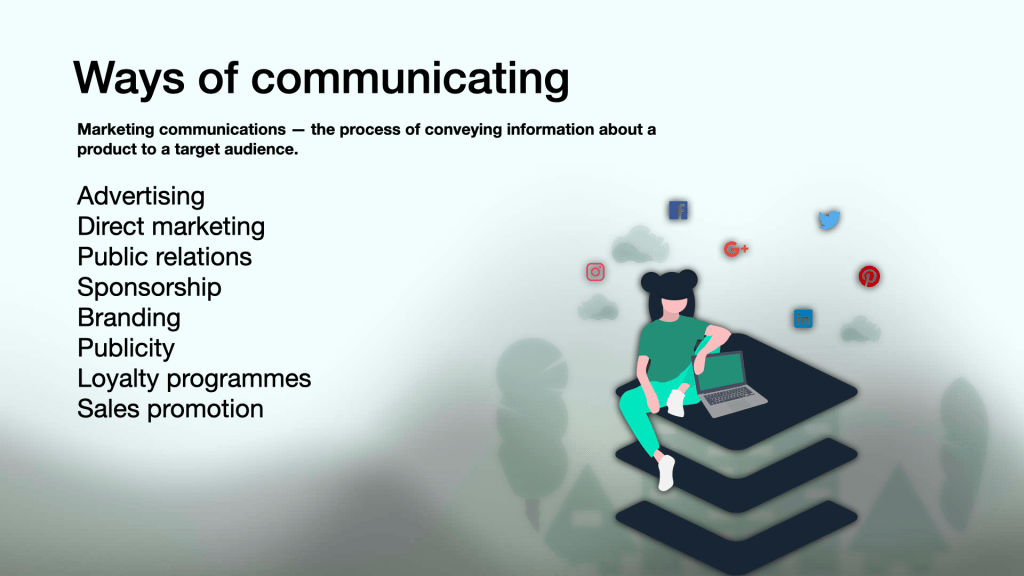
Communication with customers (marketing communications) is necessary so that the brand is recognised, to build relationships with people, and to create an emotional connection with them.
The goals depend on what the company does, so they are different for everyone. Below, we will analyse the most common ones. To convey an important idea to people, to touch their feelings, and to evoke emotions, brands use different communication methods in combination. The combination of different methods helps to work better. Let’s look at these methods in more detail.
- Advertising. A paid way to attract attention and convey information through various channels. Radio, television, social networks, and outdoor billboards are used for this.
- Direct contact. This is the transfer of information personally to the client. Companies write in messengers, send emails, SMS, and notifications to phones.
- Public Relations (PR). An essential part of the work is to create a good reputation for the brand and find loyal supporters. For this, they communicate through journalists, social networks, and events.
- Sponsorship. A great chance for more people to learn about you and for “word of mouth” to start working. Companies often provide money for holding conferences, contests, and master classes.
- Branding (Image Creation). This is work on the correct associations and the transfer of company values. Thanks to corporate colours, logo, and packaging design, customers easily recognise the product among hundreds of others.
- Publicity. Promoting the brand through news, social networks, and good deeds. This helps to establish close contact with people and strengthen trust in the company.
- Loyalty programs. They are needed so that customers stay with you for a long time. People are given bonuses and gifts for purchases or for inviting friends.
- Sales promotion. To make the product bought more often, companies arrange sales, contests, offer product samples in stores, and distribute flyers. This attracts new people and increases profits.
Now let’s look at examples of how this works.
Google and Facebook ADS
Google is primarily engaged in search advertising. This works very well because people are now so accustomed to buying: they search for answers, goods, services, and compare prices in the search.
In addition, Google helps place ads on popular sites. Visitors see exactly the advertising that is interesting to them and suits their requests. Unlike it, Facebook is a social network. Here, advertising works due to the system knowing what users do and what they are interested in within the application. Google and Facebook are similar in that they are huge. Sometimes they seem like competitors, because both want to take the main place in the internet advertising market.
Video clips are best suited for such advertising – pre-shot stories that are shown to viewers. Video is becoming more popular every year. According to statistics, more than half of people contact a company after watching a video on social networks. Video provides more benefit and sales than simple pictures or text. I am precisely engaged in this kind of promotion. I do everything “turnkey”: from idea and filming to setting up advertising for the right people. That is, I manage the entire process from beginning to end.
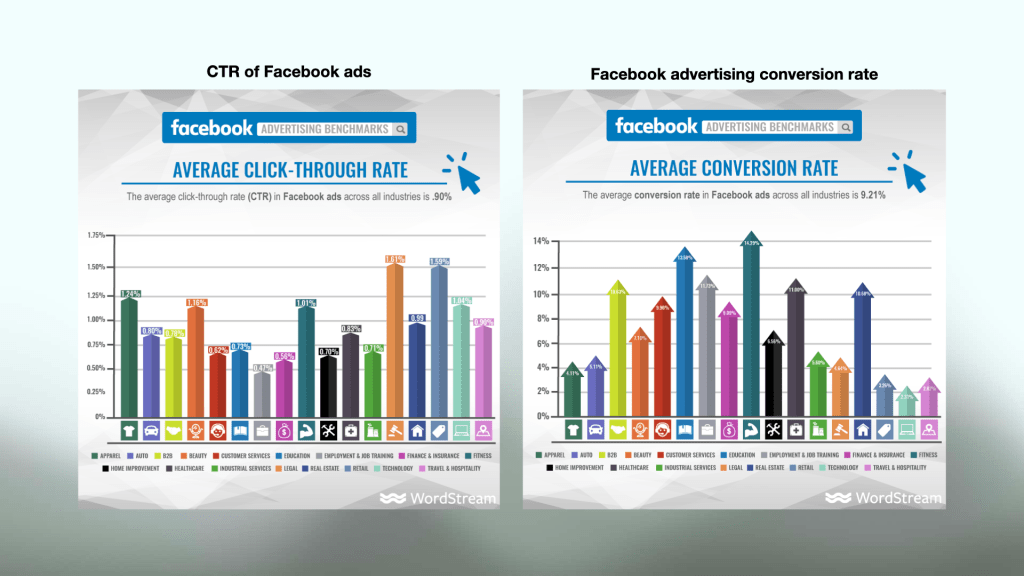
Facebook Ad CTR. The average click-through rate for Facebook advertising is 0.9%. The lowest CTR is for professional training companies- 0.47%, and the highest is for the legal industry and retail – 1.6%.
Facebook Ad Conversion Rate. The highest conversion rate is for the fitness industry – 14.30%, and the lowest is for technology and hotel companies, at less than 3%. Compare the conversion rate among other industries in the report below.
Collaborations
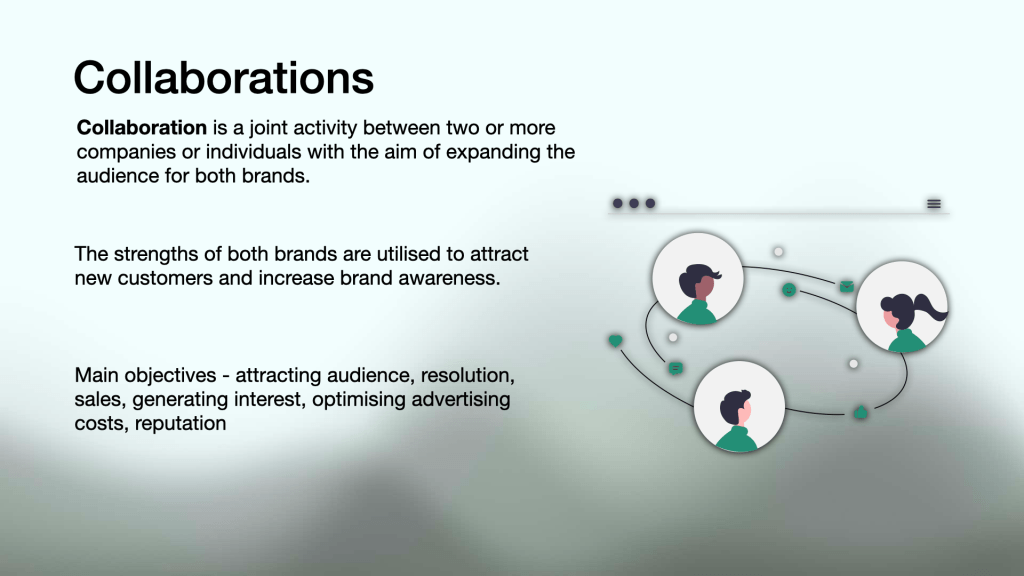
When two brands work together, they join forces to find new customers and become more famous.
For example, Nike could agree with the music company Universal Music to release special clothing for musicians. This way, Nike will find buyers in the world of music and become more popular there. This method is called a collaboration (cooperation). If a company and a famous person cooperate, they often hold contests, and the blogger becomes the face of the brand. If two companies unite, they release joint products, organise events, and launch advertising.
Here is a recent example from my experience. I, as a videographer and a designer, Anu Salo, together wrote an article about how we use AI in our work.

You can read it here, written in two languages –
We talked in detail about our views and favourite programs, as well as how this simplifies our daily tasks. Then we collected all of this into one text and published it on various websites. The main goal is to become more famous and help our sites be better searched on the internet (SEO) so that people find us more often for the necessary queries. This was work for the future, and we didn’t expect a stream of clients right away. But a couple of weeks ago, a student from Helsinki wrote to me: he is writing a thesis about how neural networks are changing animation, and he found me precisely thanks to this article.
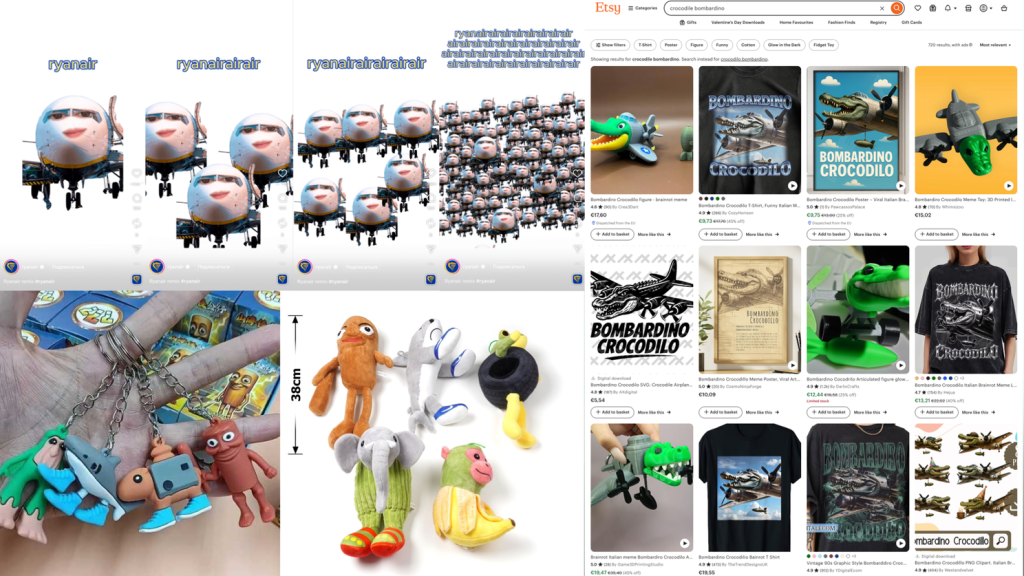
Brainrot marketing as a new wave
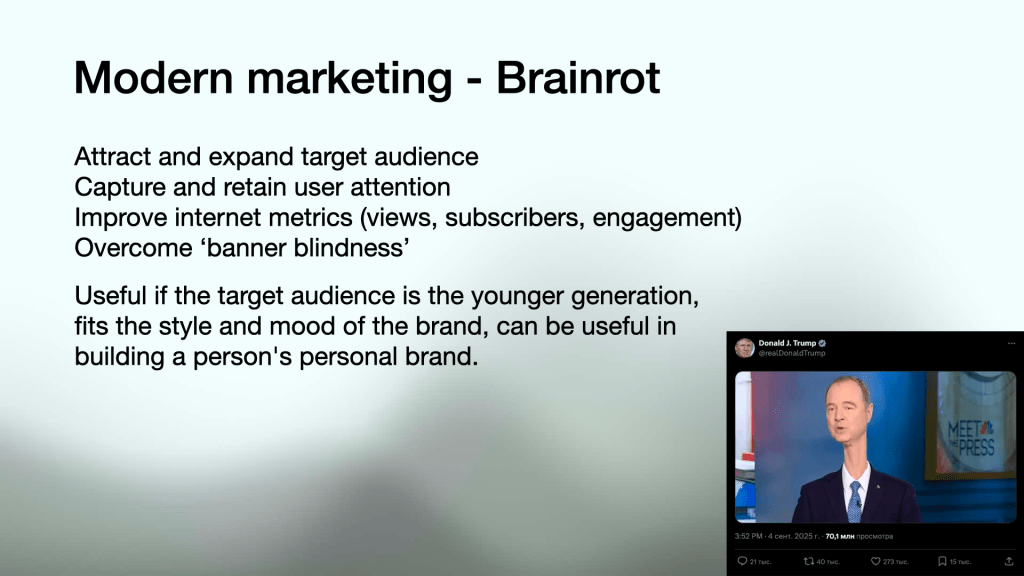
Brainrot refers to extremely low-quality, absurd, or surreal internet content that lacks any real meaning or substance. The term also describes the state of mental fogginess and cognitive decline caused by chronically overconsuming this type of media.
Here, the approach changes, we adjust products to modern trends. Sometimes the entire business is built exactly on this. What is the benefit of this?
- Youth access. Zoomers and Generation Alpha grew up with a phone in their hands. Long videos are boring for them, they are used to fast, simple, and funny content (memes and short videos). A chance to stand out. When there is a lot of similar advertising around, unusual or even “wild” content immediately catches the eye. People may argue about it, but they will not remain indifferent. Fast popularity. Funny things quickly spread across the internet. This increases brand recognition and sales. The main thing is that the audience understands the joke. You need to use such specific content carefully. Simple, but not stupid. Videos with cats often work better than complex advertising.
- People watch them willingly and without irritation. Do not copy blindly. Use only those trends that suit your brand, and be sure to adapt them for yourself. If everyone already has the trend, it won’t work. Look for the benefit in the strange. For example, ASMR videos calm people, and explaining history using cats as an example is both funny and educational for teenagers. Do joint projects with other brands and ask subscribers to shoot videos. This helps to find fresh ideas.
Differences in marketing in CIS and Finland
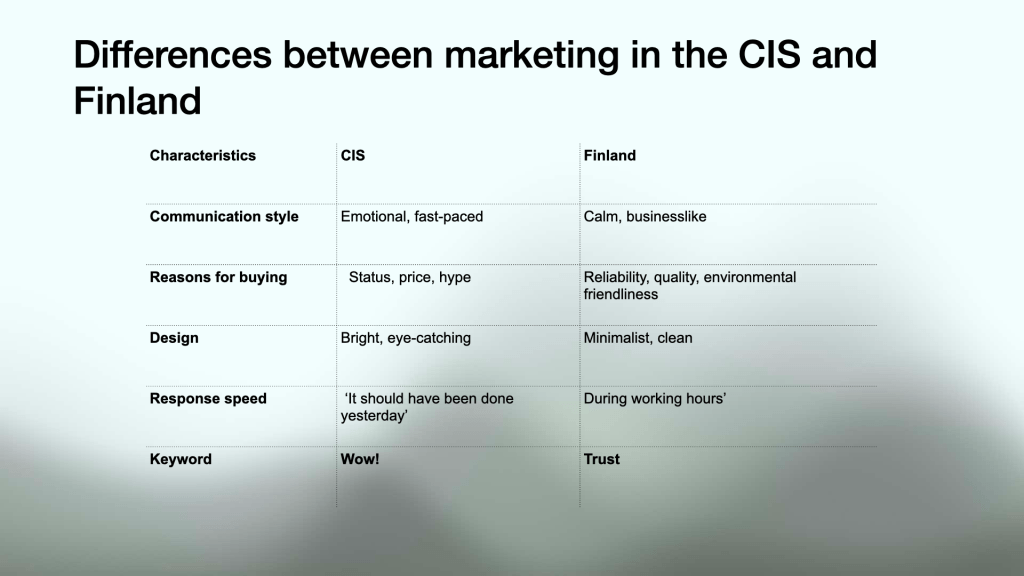
Why did I decide to mention this here? I used to live and work in the CIS, but I moved to Finland and am learning about the new realities of business and marketing in a new region, so I decided to share my experience.
We are used to showing “coolness”, bright colours, loud phrases, speed, and status. Selling is done through emotions: “Buy – and you will be happy.” In Finland, everything is different. Finns do not like being forced to buy a product. They prefer to choose for themselves. Honesty, openness, and calmness are valued here.
What is common:
- Internet. Both here and there, everyone is on their phones. If you are not on social media or your website is inconvenient, you simply won’t be noticed.
- Visuals. A beautiful appearance is important everywhere. But the style is different.
Methods that are better to FORGET. If you act the old way, Finns may get scared or take you for scammers.
- Imposition. Calls with the question “So, have you decided?”, a bunch of messages in messengers – this doesn’t work here.
- Ostentatious luxury. Gold letters, photos of expensive cars, and pathos are considered bad taste here. Even rich people in Finland look simple, so advertising should also be modest.
What to PAY ATTENTION TO To be trusted, focus on this:
- Honesty. This is the main thing. Speak and show everything as it is, without embellishment.
- Facts. Instead of the words “Wonderful cream,” write specifically: “Moisturises for 12 hours.” Less emotion, more benefit.
- Ecology. This is a way of life here. If your product is safe for nature or made by local artisans, be sure to mention it.
- Email. In our country, mailings are often considered spam, but in Finland, people actually read useful emails. This is a great way to sell.
- Patience. A client can visit the website, leave, return a week later, and only buy after a month. Decisions are made slowly here.
- Minimalism. Simple fonts, calm, natural colours. The product should be comfortable and neat, not “over-the-top.”
Summarisation and Recap
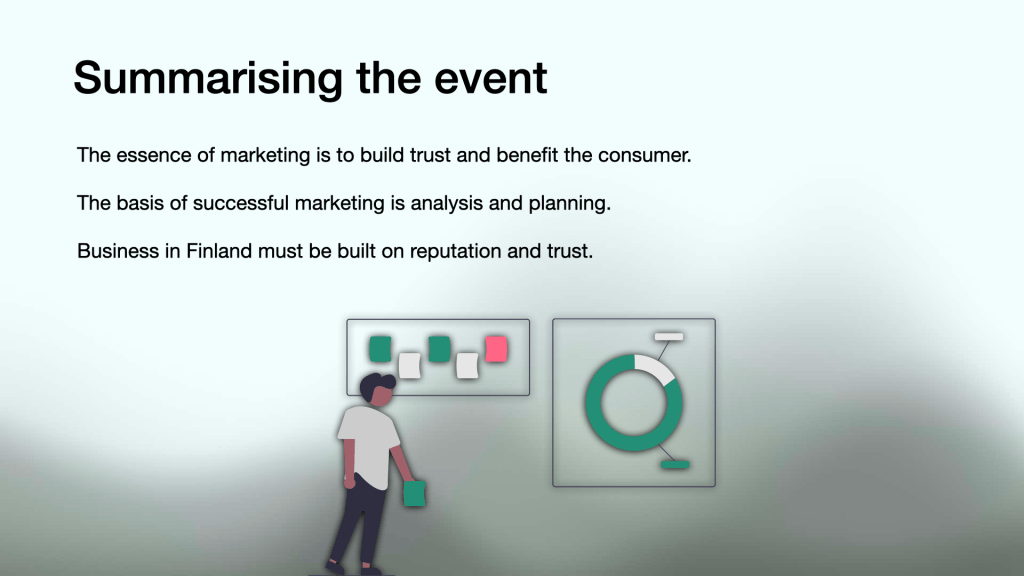
Let’s sum everything up. Marketing, as a system of trust and benefit, it is not just advertising, but a way of communicating with the client, aimed at solving their problems and satisfying their needs.
The main goal is not aggressive imposition of goods, but a deep understanding of the audience and building long-term relationships that lead to business and revenue growth. Whether it is the B2B sector with its long sales cycles or the emotional B2C, success depends on competent analytics and effective product positioning.
Adapting to the Finnish market by changing perceptions and creating a new currency of trust, where aggressive sales, luxury demonstrations, or empty promises do not work here and can scare away clients. The local market requires patience, minimalism in presentation, a focus on facts, ecological soundness, and safety.
 Renas Media